


Many businesses reach a point where running ads is no longer the main challenge. The bigger question becomes whether their current setup is strong enough to deliver clear, measurable results over time. This is where search engine marketing services start to matter more. Instead of just launching campaigns, businesses need support that connects strategy, targeting, landing pages, tracking, and optimisation into one system.
The difficulty is that not all providers offer the same depth of service. Some focus mainly on traffic and clicks, while others help businesses improve lead quality, reporting clarity, and overall campaign performance. This guide explains what search engine marketing services typically include, who they are for, how to compare providers, and what to look for when choosing the right SEM partner.

What Are Search Engine Marketing Services?
Search engine marketing services refer to professional support for planning, managing, and improving paid search campaigns. In most cases, this means helping businesses run Google Ads more effectively so they can reach people who are already searching for relevant products or services.
These services often go beyond ad setup alone. A stronger search engine marketing service may also include:
- keyword strategy
- campaign structure
- ad copy development
- landing page recommendations
- conversion tracking
- reporting and analysis
- ongoing optimisation
This is important because SEM performance is rarely driven by one single element. A campaign may bring in traffic, but if the search intent is weak, the message is unclear, or the landing page does not convert, the results may still disappoint. Good search engine marketing services help connect these moving parts so the campaign supports real business outcomes.
Who Should Consider SEM Services?
Not every business needs the same level of support, but SEM services are especially useful for companies that want faster visibility and more structured performance management.
Businesses that need leads faster
Some businesses cannot afford to wait too long for visibility to build gradually. Paid search helps them appear when potential customers are already searching, which can make it a practical option for lead generation and demand capture.
Businesses with active campaigns but unclear results
A business may already be spending on Google Ads but still struggle to answer simple questions. Are the right keywords being targeted? Are the leads actually relevant? Is the landing page helping or hurting performance? If those answers are unclear, outside support may be useful.
Businesses with higher-value conversions
For businesses where each lead matters more, such as B2B services, high-ticket solutions, or multi-step sales processes, SEM often needs tighter control. Lead quality, tracking accuracy, and follow-up flow become more important than just click volume.
Teams that need stronger structure
Some internal teams can execute campaigns, but still need help with strategy, reporting, and optimisation discipline. In these cases, the right SEM partner can strengthen the system without replacing the internal team completely.
What a Good SEM Service Should Include
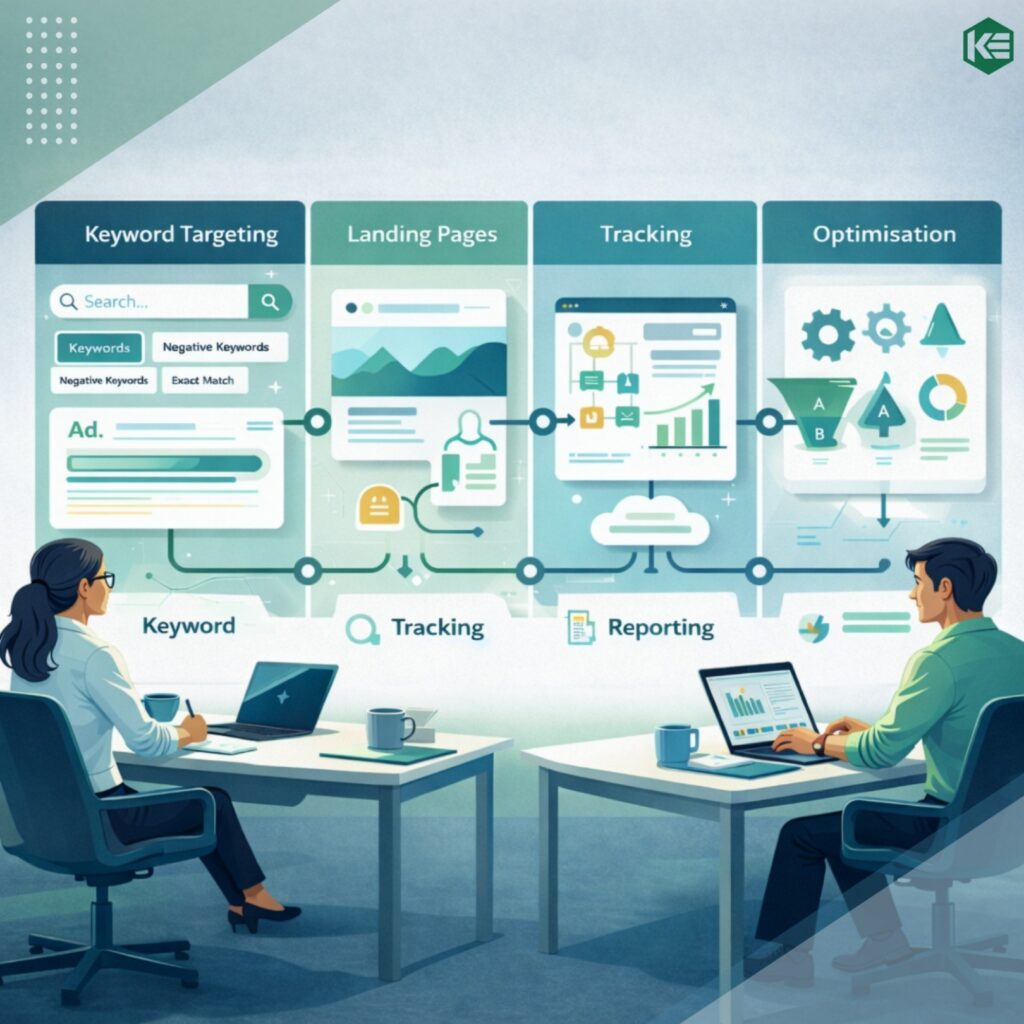
When comparing search engine marketing services, it helps to look beyond surface-level deliverables. A good provider should not only run ads, but also help improve the full performance system around them.
Core parts of a strong SEM service
| Area | What a Good SEM Service Should Include | Why It Matters |
| Keyword targeting | Intent-focused keyword research, search term review, negative keywords | Helps attract more relevant traffic instead of wasting budget on poor-fit searches |
| Campaign structure | Clear segmentation by offer, audience, or objective | Makes campaigns easier to manage, optimise, and measure |
| Ad messaging | Ad copy aligned with user intent and offer clarity | Improves click quality and relevance |
| Landing page alignment | Recommendations to improve page-message match and conversion flow | Helps turn clicks into enquiries, leads, or sales |
| Conversion tracking | Setup for meaningful actions such as forms, calls, WhatsApp, or purchases | Makes it easier to judge real business performance |
| Reporting | Clear performance reporting tied to useful business outcomes | Helps decision-makers understand what is working |
| Optimisation | Ongoing testing, search term review, bid adjustments, and improvement cycles | Prevents campaigns from stagnating over time |
A provider that only talks about impressions, traffic, or click volume may not be giving enough attention to the full picture. Businesses should look for partners who understand that campaign success depends on the relationship between traffic quality, landing page performance, tracking, and conversion outcomes.
SEM Agency vs In-House Support
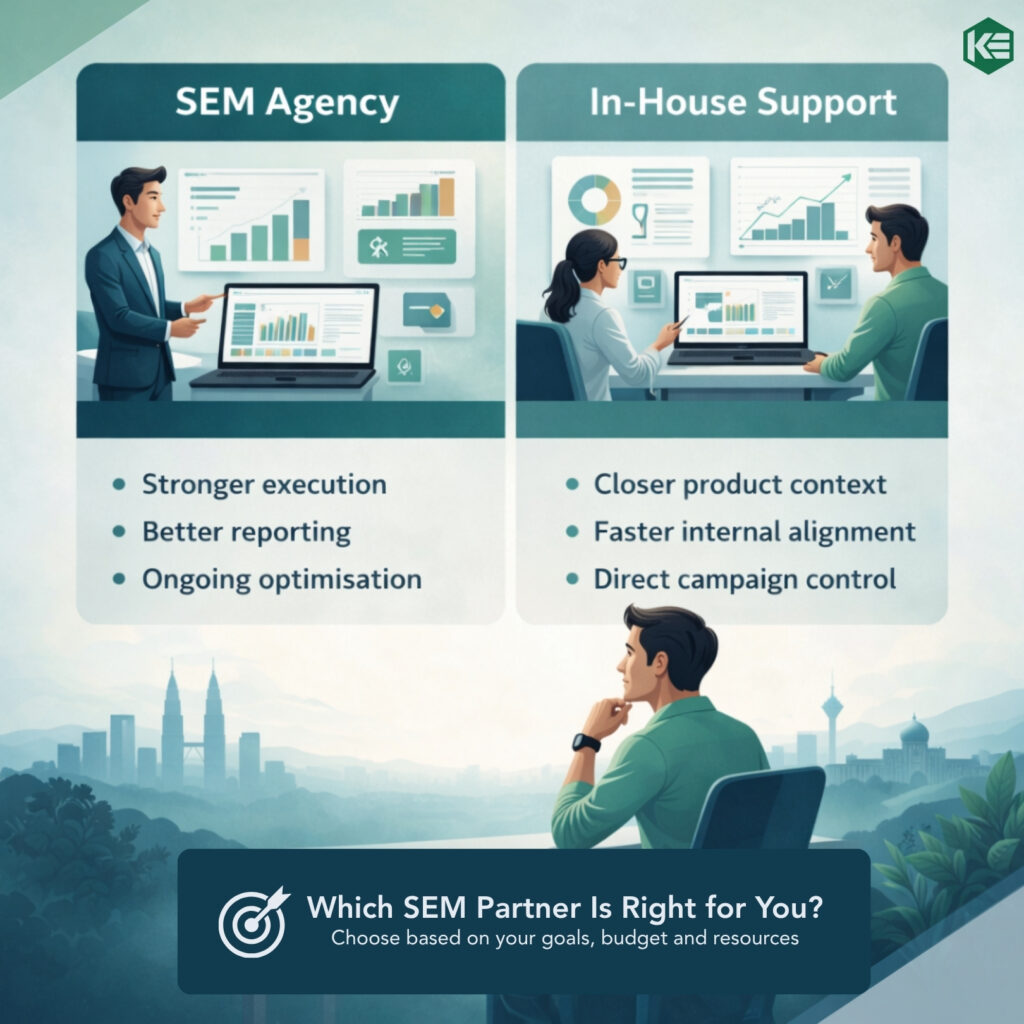
Businesses do not always need the same type of support. The best choice depends on internal resources, growth goals, reporting needs, and campaign complexity. For some businesses, in-house SEM management is enough for the current stage. For others, working with an SEM agency makes more sense when stronger strategy, optimisation, and accountability are needed.
| Setup | Best For | Strengths | Limits |
| In-house support | Teams with strong internal SEM capability and enough time to manage campaigns | Closer product understanding, faster internal communication | Can become difficult if strategy, tracking, or optimisation discipline is weak |
| SEM agency | Businesses that want structured campaign management and ongoing optimisation | Often stronger for execution, reporting, testing, and accountability | Fit depends on service quality and how well the agency understands the business |
There is no single setup that suits every business. Some teams manage SEM effectively in-house for a period of time, while others need agency support to improve structure, reporting, and campaign performance. The key is to choose based on what the business actually needs, not just what sounds more advanced.
How to Evaluate the Right SEM Partner
Choosing the right SEM partner should be about more than package lists or surface-level promises. A better evaluation process looks at how the provider thinks, how they measure success, and how they support performance over time.
1. Look at how they define success
If the provider focuses mainly on clicks, impressions, or traffic, the picture may be incomplete. A stronger partner should be able to talk about:
- conversion quality
- tracking accuracy
- landing page fit
- reporting clarity
- optimisation process
- business outcomes over time
2. Ask what is actually included
Some providers only manage ads. Others also support tracking, landing page recommendations, reporting structure, and strategic decision-making. The business should be clear about whether it only needs execution or whether it needs a more complete SEM partner.
3. Evaluate reporting clarity
Reporting should help decision-makers understand performance without getting lost in vanity metrics. Businesses should be able to see not just what happened, but what matters and what should happen next.
4. Check how they approach optimisation
A good SEM partner should have a clear process for reviewing campaign performance and improving results. This includes search term analysis, ad testing, bid adjustments, targeting refinements, and page-level recommendations where needed.
5. Assess fit with your business model
A provider may be technically strong but still be the wrong fit if they do not understand your lead flow, sales process, or decision cycle. This matters even more for businesses with high-value or multi-step conversions.
Red Flags to Watch for When Comparing SEM Services
Not every provider is a good fit, and some warning signs appear early if you know what to look for.
Common red flags when evaluating SEM providers
| Red Flag | Why It Matters |
| Overpromising fast results without understanding the business | SEM can deliver faster visibility, but strong results still depend on offer quality, targeting, landing pages, and tracking |
| Focusing only on traffic or clicks | Traffic alone does not guarantee lead quality or business outcomes |
| Weak explanation of tracking and measurement | Without proper tracking, it becomes hard to judge whether campaigns are actually working |
| No clear optimisation process | Campaigns often need regular review and improvement to stay effective |
| No interest in landing page quality or conversion flow | Even strong traffic can underperform if the destination page is weak |
| Vague reporting | Businesses need clarity, not just data dumps |
| One-size-fits-all service positioning | Different industries and growth stages need different SEM approaches |
A provider does not need to promise perfection, but they should be able to explain their process clearly, define what they are responsible for, and show how they connect campaign activity to meaningful outcomes.
When to Hire an SEM Partner Instead of Managing Campaigns Alone
Some businesses can manage campaigns internally, especially if they already have the right skill set in-house. But many teams reach a point where managing search ads alone becomes harder to sustain.
It may be time to work with an SEM partner when:
- results remain unclear despite ongoing spend
- internal execution is inconsistent
- lead quality is weak or unpredictable
- tracking is incomplete or unreliable
- ad and landing page alignment is poor
- optimisation happens too irregularly
- leadership wants stronger accountability and reporting
A business does not always need to choose between full outsourcing and full internal ownership. In many cases, the best setup is collaborative. The internal team brings business context, while the external partner strengthens strategy, structure, optimisation, and reporting.
How the Right SEM Partner Supports Better Business Outcomes
The real value of a strong SEM partner is not just campaign execution. It is the ability to make the whole system more accountable and easier to improve.
That usually means:
- clearer targeting
- better traffic quality
- more aligned ad and landing page flow
- stronger conversion measurement
- more consistent optimisation
- reporting that leadership can actually use
Over time, this helps the business move from “we are running ads” to “we understand what is working, what is underperforming, and what to improve next.” That shift is often what separates activity from real performance management.
How This Connects to the Bigger SEM Picture
Choosing the right service partner becomes easier when the business already understands how SEM works at a practical level. If you are still evaluating the basics of search engine marketing, including how campaigns work in Malaysia, who should use SEM, and what drives performance, it helps to review the broader foundation first.
That is why this provider-comparison article works best as the next step after understanding the basics of search engine marketing. Once the business knows what a strong campaign should include, it becomes easier to compare providers more clearly.
Ready to Choose the Right SEM Partner?
Search engine marketing services should do more than just keep campaigns active. The right SEM partner should help your business improve targeting, messaging, tracking, optimisation, and reporting in a way that supports real growth.
If you are comparing search engine marketing services, the goal is not simply to find someone who can run ads. The goal is to find a partner who can connect campaign execution to business outcomes with more clarity and consistency.
Explore our SEM Management Service to see how a more structured approach can help improve campaign performance, reporting clarity, and overall lead quality.
FAQ
What are search engine marketing services?
Search engine marketing services refer to professional support for planning, managing, and improving paid search campaigns. They often include keyword strategy, ad management, landing page recommendations, tracking, reporting, and ongoing optimisation.
How do I choose the right SEM partner?
Look beyond traffic and clicks. A good SEM partner should be able to explain how they handle keyword targeting, conversion tracking, optimisation, reporting, and campaign alignment with business goals.
What should an SEM service include?
A stronger SEM service should include strategy, campaign structure, ad messaging, landing page alignment, conversion tracking, reporting, and ongoing optimisation.
Should I hire an SEM agency or manage campaigns in-house?
It depends on your internal capability, time, reporting needs, and campaign complexity. Some businesses manage basic campaigns internally, while others benefit from agency support for strategy, optimisation, and accountability.
When is the right time to hire an SEM service provider?
It may be the right time when results are unclear, tracking is weak, lead quality is inconsistent, or your team lacks the time or expertise to improve campaigns consistently.
Last updated: March 26, 2026